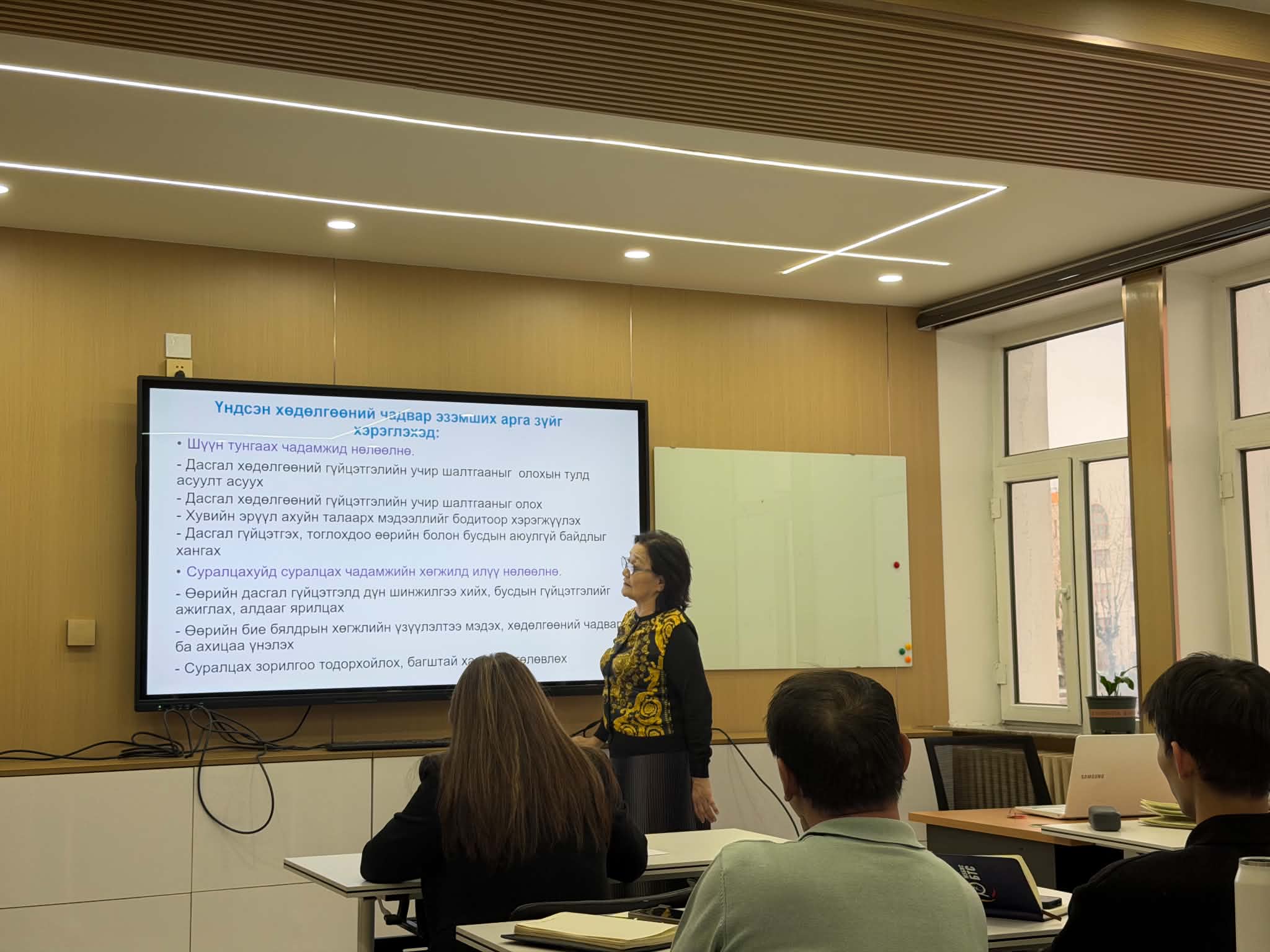
On November 18, 2026, the Department of Physical Education and Movement Therapy at the School of Physical Education, Mongolian National University of Education (MNUE) organized a seminar entitled “Revision of the Primary Education Physical Education Curriculum.”
The seminar was conducted by Consulting Professor L. Urtnasan from the Department of Sports Theory and Methodology, who also serves as the Secretary of the Working Group responsible for developing the revised primary education physical education curriculum.
During the seminar, faculty members of the School of Physical Education were introduced to the conceptual framework, objectives, content, teaching methodologies, and key features of the revised curriculum.
The seminar focused on the rationale for revising the primary education physical education curriculum, competency-based learning outcomes, curriculum content, teaching methodologies, learning environments, and assessment approaches.
The revised curriculum emphasizes competency-based education, aiming not only to improve pupils' physical development and motor skills but also to foster creativity, critical thinking, communication, collaboration, learning-to-learn skills, social and emotional development, and appreciation of national and global cultural heritage.
Particular attention was given to the revised curriculum structure, which is organized around two main learning domains: “Movement” and “Physical Development.” The learning process is designed to progress through three stages: understanding movement, performing movements independently, and applying movement skills creatively.
The seminar also highlighted two major instructional approaches: fundamental movement skill development and game-based learning. These approaches encourage active participation, cooperation, independent learning, safety awareness, and inclusive teaching practices that accommodate pupils' diverse developmental needs.
The seminar provided an important opportunity to examine how the revised primary education physical education curriculum can be integrated into pre-service teacher education, particularly in preparing future teachers to implement competency-based instruction effectively.
The key outcomes and contributions of the seminar included:
Enhancing understanding of curriculum reform. Faculty members gained insight into the revised curriculum's conceptual framework, competency-based learning objectives, expected learning outcomes, content, and instructional approaches.
Identifying directions for improving teacher education. The seminar emphasized the importance of equipping pre-service teachers with the knowledge, practical movement skills, lesson-planning competencies, and pedagogical methods necessary to implement the revised curriculum.
Exploring practical applications of competency-based lesson planning. The seminar materials included group-based practical activities focused on Grade 1 learning outcomes, such as walking, climbing, crawling, personal hygiene, and safety awareness. These activities illustrated how learning outcomes can be translated into competency-oriented teaching and learning tasks.
Promoting learner-centered teaching methodologies. The importance of game-based learning, active pupil participation, differentiated instruction, and developmentally appropriate teaching strategies was emphasized as a key consideration for teacher preparation.
Supporting professional development and academic collaboration. The seminar created opportunities for faculty members to engage with curriculum reform and consider ways to strengthen the alignment between teacher education curricula, pedagogical practices, and practical teaching experiences.
The seminar represented a meaningful contribution to strengthening the capacity of the School of Physical Education at MNUE to prepare future teachers capable of implementing the revised primary education physical education curriculum.
Moving forward, it will be important to integrate the revised curriculum's conceptual principles and competency-based pedagogical approaches into relevant teacher education courses, align student teaching practices and lesson planning with the new learning outcomes, and further promote collaboration among faculty members.
These efforts will contribute to improving the quality and relevance of physical education teacher preparation and supporting the effective implementation of curriculum reform in Mongolia's primary education system.
School of Physical Education
Mongolian National University of Education (MNUE)